
僵尸世界大战
Harbin brings winter indoors in height of summer_我的网站

A | Alejandra Palacios found herself moving from summer heat to winter chill in just a matter of minutes. One moment, she was strolling in almost 30 C warmth in summer clothes; the next, she was bundled in a thick down jacket as the temperature plunged to around minus 10 C. Inside an ice-and-snow pavilion at Harbin Ice-Snow World in northeastern China, the Nicaraguan visitor wiped the fog from her phone lens to reveal an ice-carved castle and cathedral glowing in violet-blue light. Snowflakes drifted down as tourists swooshed down ice slides on rubber tubes. "They've brought winter into summer, and carved the ice into something so magnificent and delicate. It's astonishing," she said. Harbin, the capital of Heilongjiang province, is known as China's "Ice City" for its freezing winters, ice sculptures and winter sports. After the outdoor section of Harbin Ice-Snow World, the world's largest ice-and-snow theme park, closed this February, its indoor ice-and-snow pavilion took over, offering visitors a cool escape from the summer heat. According to Sun Zemin, deputy marketing director at Harbin Ice-Snow World, the pavilion opened in the summer of 2024. The 23,800-square-meter venue maintains an interior temperature between — 8 C and — 12 C and uses about 20,000 cubic meters of ice. "The pavilion features natural ice harvested from the Songhua River in winter and preserved at low temperatures in sealed storage, as well as colored ice, bubble-free ice and frozen roses made by ice-making factories," Sun added. Those who visit the park can also enjoy indoor ice shows that combine figure skating, acrobatics and live music. Ashley Martinez Aponte, a visitor from the Dominican Republic, lingered long after the performance had ended. "It was such an unforgettable show. I think everyone should come and appreciate this piece of art on ice," she said. The park's operator said that the pavilion's single-day visitor count exceeded 5,000 at its peak this summer. The park draws not only domestic tourists escaping the heat from southern China, but also travelers from Singapore, Malaysia, the Republic of Korea and other countries. Beyond the ice sculptures, shows and rides, off-season winter sports are emerging as a new draw for Harbin's summer tourism — a fresh way of turning its winter chill into a hot season attraction. At a year-round indoor ski resort in Harbin's Songbei district, beginners have been learning turning and braking with coaches this summer, while seasoned skiers race down the slopes, kicking up clouds of snow. Lin Shuyue, a senior student from Xiamen in East China's Fujian province, recently visited Harbin with her classmates on a graduation trip. Though they have access to indoor ski slopes back in the south, they made a point of adding this ski resort to their itinerary. "You can ski indoors in the south too, but it just doesn't feel the same as the 'Ice City'," Lin said, adding that with greater vertical drops, more advanced slopes and the city's immersive ice-and-snow culture, skiing in the height of summer here is a truly unique experience. Spanning around 80,000 sq m, the indoor ski resort features eight slopes of varying gradients, with a maximum vertical drop of 80 m. It's the perfect venue for skiers of all skill levels. Thanks to its year-round temperature control and snow-making systems, ski training and recreation are no longer limited by the weather outside. "We are committed to making winter sports accessible all year round, creating all-season, all-age ice-and-snow experiences," said Song Guangxu, who is in charge of the resort. In addition to daily operations and ski instruction, the facility also helps sustain visitor flows by hosting professional competitions, family-oriented events and public ice-and-snow experience programs. These indoor ice-and-snow projects are weaving themselves into Harbin's broader summer tourism market, fueling a travel boom during the peak season. Travel platform data shows that flight bookings from major cities across the country to the "Ice City" have surged since late June, driven by a combination of graduation trips and family summer getaways, with young travelers making up a significant share of the city's summer visitors. Li Zhuomin, deputy director of the Harbin city bureau of culture, radio, television and tourism, said the city is building a more stable year-round supply of ice-and-snow products through projects such as indoor theme parks, ice-art exhibitions and indoor ski resorts. China's ice-and-snow economy exceeded 1 trillion yuan ($147 billion)in 2025, according to a report released this year by the China Tourism Academy. Indoor ice-and-snow complexes have become one of the most active investment categories in the sector, further breaking down the climatic and seasonal constraints on ice-and-snow consumption. 
 。
。
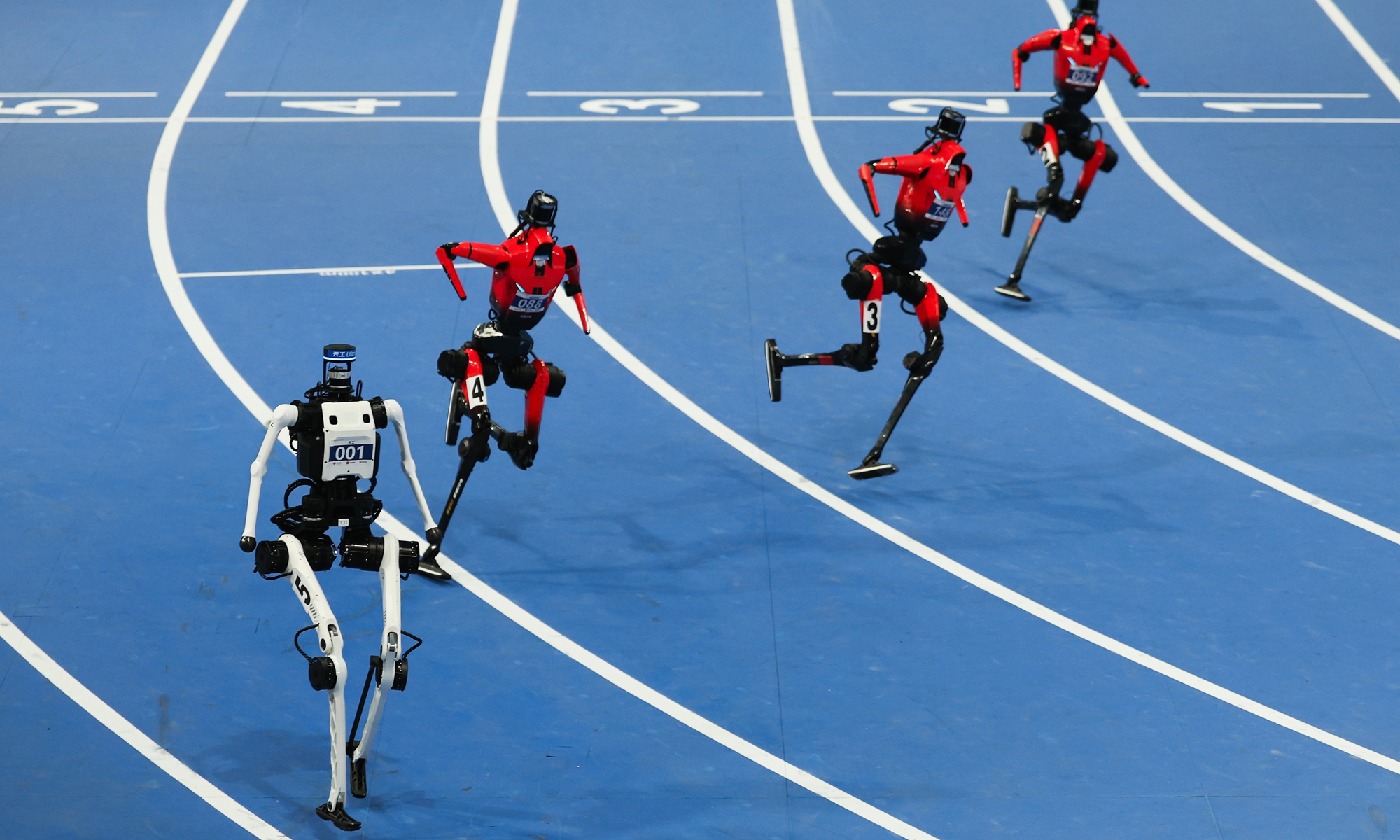
On the blue track inside the National Speed Skating Oval, robots chased each other in the 400-meter race. A sprinting Tien Kung robot was tripped by a rival robot lying on the track but did not fall. Instead, it adjusted its posture in seconds and continued toward the finish line with a result of 38.15 seconds, breaking human 400-meter race world record of 43.03 seconds, held by South African athlete Wayde van Niekerk.
This scene unfolded on Sunday, the first official competition day of the 2nd World Humanoid Robot Games (WHRG). Later that evening, a humanoid robot named Lightning, developed by Honor Co., broke the long-standing human 1,500-meter world record of 3:26 set by Moroccan athlete Hicham El Guerrouj with a time of 2:30.22. Just one night earlier, during the opening ceremony's 100-meter sprint and high jump demonstrations, humanoid robots had already shattered records long held by human athletes Usain Bolt and Javier Sotomayor — merely an appetizer for the five-day sci-fi spectacle.
The Games have attracted 666 teams from 16 countries across six continents, up 138 percent from its inaugural edition. The number of participating robots quadrupled to 2,056, the Global Times learned from the organizing committee.
Yet the biggest change this year was not only the scale, but also the technological maturity. More teams have shifted from remote-controlled robots to fully autonomous systems. Chinese observers, after watching several events, said humanoid robots are no longer limited to simple demonstrations of walking or dancing. Increasingly, they are being tested in environments that demand speed, coordination, perception and decision-making.
From movement to intelligence
Behind the record-breaking performances are a series of technological upgrades. During the running events, Global Times reporters observed that robots were able to make subtle movements around their hip joints while walking, allowing them to maintain balance and produce movements closer to human biomechanics.
Guo Yijie, technical director of Tien Kung Ultra, said the improvement came from advances in hardware design.
"Robot joints have improved in torque and speed. As competitions demand higher power output, the reliability of the main control board, power board and high-power battery discharge capability have become increasingly important," Guo told the Global Times.
According to Guo, the same Tien Kung Ultra robot was used in both sprinting and jumping events. For running, the waist needs rotation to balance the inertia generated by leg movements. For jumping, the upper body requires pitching movement to help the robot achieve greater distance or height, Guo said, noting that these can all be achieved with only slight adjustments to the waist configuration were needed, and it highly demonstrated to the robot design's flexibility.
Besides the hardware upgrades, developments in robots' faster decision-making in "brains' is better showcased in football competitions.
The Booster T2 robot used by many domestic and overseas football teams has increased its onboard computing capability by 10 times compared with the previous generation. The time from recognizing the goal to deciding whether to pass or shoot has been reduced to around 100 milliseconds - faster than the time humans usually need to blink.
Cheng Hao, a technical representative from Boosters Robotics, said the improvement represents an "end-to-end" transformation in embodied intelligence.
"In the past, robots relied on separate steps: perception, planning, decision-making and execution. Each stage was disconnected. Now, with an end-to-end motion foundation model, visual input can directly generate joint control commands," Cheng said.
The newly introduced table tennis and tennis competitions are also testing another important capability: perception.
"Robots are moving from simply recognizing the three-dimensional position of a ball to understanding the movement information of opponents and more complex environments," said Li Yinghui, a postdoc researcher and the leader from the Hong Kong University team at the table tennis event. Such capabilities developed in sports scenarios could eventually be transferred to other scenarios in industries or daily life, Li said.
Beyond entertainment
Though clips from the robot competitions have made a buzz on social media, with some critics from Western media questioning why robots need to dance, play football or compete in athletics while arguing that these activities appear far from everyday needs.
Zhou Changjiu, Vice President of the RoboCup Federation and the Robotics Competition Association of the Asia-Pacific (RCAP), stressed robot sports are not designed for entertainment alone. "Robot competitions are testing the capabilities needed for humanoid robots to enter the real world," Zhou told the Global Times.
Different events evaluate different abilities. Sprinting tests speed, marathons examine battery endurance and energy management, while football provides a comprehensive test because of its dynamic and unpredictable nature, testing intelligence, manipulation, interaction, safety, cost and trust at the same time, Zhou said.
Unlike a single-task demonstration, football requires robots to cooperate. Players must understand their own roles, recognize teammates and opponents, and make collective decisions - a form of swarm intelligence that could become essential when robots work together in homes, factories and emergency rescue environments.
Entertainment, however, can generate business opportunities. Gu Jinghai, brand director of EYOU Robot Co, told the Global Times that the company sold 95,000 integrated joints in China in 2025 and expects sales to exceed 1 million units in 2026. Growth mainly comes from planetary joints used in entertainment robots, while harmonic joints for industrial robots are also expanding steadily, he said.
Jiao Jichao, an executive from UBTECH Robotics, said the criticism that "Chinese robots can only sing and dance" reflects only a temporary stage of development. "Performance and dancing are also real commercial demands, and their existence has value," Jiao said. "Beyond entertainment, Chinese robots are already demonstrating intelligent capabilities that support practical applications in manufacturing, and partnerships with companies including Huawei and Foxconn, where robots have already entered production lines in small-scale applications."
The Outline of the 15th Five-Year Plan for National Economic and Social Development of China stated that the country will construct a comprehensive cultivation system for future industries including the embody intelligence as new economic growth drivers.
Zhou said the development of humanoid robots is not only about individual machines, but about building an entire ecosystem.
China's advantage lies in its complete supply chain, abundant application scenarios and manufacturing capabilities, while the fast growing industry still faces challenges such as the lack of unified standards.
Gu said the company has launched mass production of robotics joint under domestic standard of auto parts.
Robot competitions can help address these issues by creating common standards in areas such as competition rules, robot dimensions, communication systems, batteries and joint modules. "As applications expand, the cost of key robot components will continue to decline," Zhou said.
"Numbers are magic," Zhou said. "If producing one robot costs a huge amount because it is handmade, producing one million robots will completely change the cost structure."
For humanoid robots, the race taking place inside the Ice Ribbon may not ultimately be about who crosses the finish line first. It may be about whether these machines can learn to navigate the far more complicated race outside the stadium - the race into the real world.
。
Current article:http://yf1b90.shuicengchongmingnouhuawang.bond/20jlnpv/20260826/3930.html
Published on:16:32:36
 亲爱的公主病
 等着我
等着我